
Demand on Duty
Support your people. Serve your community.
Demand on Duty™ is a time-based police resource modelling tool that helps leaders understand the gap between scheduled staffing and actual deployable capacity. It analyzes real workload, availability, and demand patterns to align resources with when and where they’re needed most. The result is clear, evidence-based insight to support defensible staffing decisions, reduce overtime reliance, and protect officer wellbeing.
Time-Based Police Resource Modelling for defensible police staffing decisions
Move beyond population-based assumptions and high-level crime statistics. Demand on Duty™ helps you understand real workload and capacity, identify peak demand, and align resources with when and where calls occur, so you can make confident, evidence-based staffing decisions.
Demand on Duty™ supports police leaders to balance community expectations with sustainable workloads and officer wellbeing.
BOOK a DEMO ‘how it works’ VIDEOModern policing requires accountable, evidence-based staffing decisions
Police services are operating under increasing pressure:
- Rising expectations for response times and service levels
- Overtime pressure, leave impacts, retention and recruitment constraints
- The need to protect proactive policing while maintaining call response levels
- Increased scrutiny from staff, boards, councils, and the public
Leaders are expected to demonstrate that staffing decisions are fair, transparent, and aligned with service expectations, while maintaining workforce sustainability.
What Demand on DutyTM enables: A clear, operationally grounded view of demand, capacity, and performance so leaders can explain staffing needs and trade-offs with confidence.
A 12-hour shift does not equal 12 hours of deployable policing time
Traditional models assume scheduled hours equal frontline capacity. In reality, that time is reduced by:
- Briefings and training
- Breaks and meetings
- Supervision and administrative work
- Court time and reporting
- Leave, sick time, and real-time availability impacts
In practice, a 12-hour shift often translates to significantly less deployable time.
“Overwork and not enough time for proper rest and family takes a real toll on officer wellbeing, not to mention the budgetary implications of overtime.”
~ Sunny Parmar (MOM, MSc., Supt. RCMP (Ret)
Why this matters to leaders: When demand exceeds deployable capacity, overtime becomes the default pressure valve, which affects budgets, wellness, and the ability to deliver proactive policing.
The questions leaders are asked, but legacy models cannot answer
Traditional approaches often cannot answer critical operational questions like:
- Where is overtime being generated, and what would sustainably reduce it: staffing, watch design, or policy changes?
- How do we explain resourcing needs clearly to staff, boards, councils, and ministries?
- What is our true deployable capacity today, this week, and this quarter?
- Are we missing targets because of structural workload imbalance or short-term availability shocks?
- What does it actually take to meet priority response-time targets without eroding proactive policing?
“In a typical day, going from call to call, you might just be meeting your target response times, but that doesn’t account for the follow-up time required for calls or the proactive work that we know is so important for community safety and is highly valued by the community and our membership.”
“When there’s no time to get everything done, that work shifts to the next day, or you just have to stay late and do admin work and sacrifice work-life balance.”
~ Galib Bhayani (MOM, MSM, C/Supt. RCMP (Ret)
Demand on Duty turns demand, availability, and targets into decision-ready insight
Demand on Duty™ is Deetken’s Time-Based Police Resource Modelling approach that helps you:
- Make staffing decisions that are transparent, defensible, and measurable
- Understand real workload and how it changes over time
- Identify peak demand periods and service pressures
- Align staffing with when and where demand occurs
- Balance reactive demand with proactive policing
Outcome: Staffing decisions that are transparent, defensible, and tied to service expectations.
How it works: from data to defensible decisions
A simple, practical approach built for real policing operations:
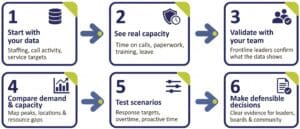
1. Start with your data
We bring together your staffing information, call activity, and service targets to create a complete picture of how your service is operating today.
2. See real capacity
We account for everything that affects availability – time spent on calls, paperwork, training, leave, and other real-world factors – so you can see how much frontline capacity you truly have.
3. Validate with your team
Operations officers and frontline leaders confirm that what the data shows reflects what is happening on the ground.
4. Compare demand & capacity
We map when and where demand occurs, identify peak periods and locations, and highlight gaps where workload exceeds available resources.
5. Test scenarios
Explore response targets, overtime, and proactive time. Understand trade-offs and see the impact of different decisions before acting.
6. Make defensible decisions
Turn insight into clear, evidence-based decisions you can confidently communicate to leadership, boards, and the community.
What changes with Demand on Duty™
- Make staffing decisions with confidence using clear, measurable data
- Reduce overtime pressure by identifying structural workload gaps
- Protect proactive policing time while meeting response expectations
- Improve response performance by aligning staffing to peak demand
- Clearly communicate needs and trade-offs to boards, councils, and the public
“It’s so important for police leaders today to be able to clearly demonstrate the real implications of staffing decisions when seeking budget approval from boards and councils. When the community expects specific response times or proactive policing targets, being able to clearly articulate the resourcing required to meet those targets is imperative.” ~ Galib Bhayani (MOM, MSM, C/Supt. RCMP (Ret)
Deetken Policing Consulting Services: from model design to adoption
Deetken supports implementation from analysis to real-world application:
- Measure actual workload, including time, variability, and call distribution
- Analyze service patterns to understand delays and peak demand
- Design effective deployment models across time, geography, and priorities
- Link insights to workforce planning, budgeting, and operational strategy
To learn more about how Deetken’s expert advisory supports policing and public safety organizations, visit Policing Consulting Services.
Make the right data-driven decisions, faster and with confidence
Demand on Duty™ helps you:
- Strengthen accountability and transparency
- Justify staffing and budget requests with evidence
- Reduce reliance on overtime
- Improve service performance
- Protect workforce wellbeing
Demand on Duty | Features & Functionality
Deetken’s Demand on DutyTM is built for command staff, operations, and oversight reporting:
Operational visibility (capacity you can trust)
- Understand true deployable time – not just scheduled hours
- Track availability impacts such as leave, training, and absences
- View performance across daily, weekly, monthly, and annual timelines
Performance and service-level management
- Set response-time goals and understand staffing required to meet them
- Identify peak demand periods and adjust staffing accordingly
- Understand where delays occur and what is driving them
Deployment and planning
- Support deployment decisions across time and geography
- Align staffing with call load, priorities, and community needs
- Assess capacity for proactive policing
Budgeting and workforce planning
- Quantify overtime and model trade-offs (e.g., overtime vs hiring)
- Build defensible staffing and budget models
- Support recruitment and retention planning
Governance-ready outputs (council/board)
- Clear, easy-to-understand reporting for boards and councils
- Transparent link between staffing decisions and service outcomes
Built for your context
- Adapted to your local policies, agreements, and operating environment
- Reflects real-world constraints such as shift structures and staffing rules

Generous Paid Vacation
Deetken values work-life balance and flexibility because we know we all work best when we have had time to recharge. That’s why we offer 4 weeks paid vacation time plus 1 week paid time off during the winter holidays for all new hires.

Flexible Work Arrangements
We offer hybrid working options that allow team members to work from home when necessary.

Collaborative and Fun Work Environment
We hold regular social events – both in-person and virtual – so you can bond and connect with your colleagues outside of work.

Individualized & Accelerated Career Growth
We invest in helping you grow your career at Deetken by providing clear role expectations, formal performance reviews every 6 months and personalized professional development plans that are aligned to your personal and professional goals.

We’re Growing!
We now have an office in Victoria, BC, and are serving clients in Alberta, Ontario and Los Angeles, CA. We have grown more than 50% since 2019 (pre-COVID). We are always looking for qualified candidates to join our team.
Headline
Headline
Ready to move from assumptions to defensible staffing decisions?
CONTACT US
Complete the form below to speak with one of our policing consulting advisors and book a demo.